8 Aug 2026 • 9 min read
NEC License Exam Preparation: The Complete Guide for Engineering Graduates in Nepal
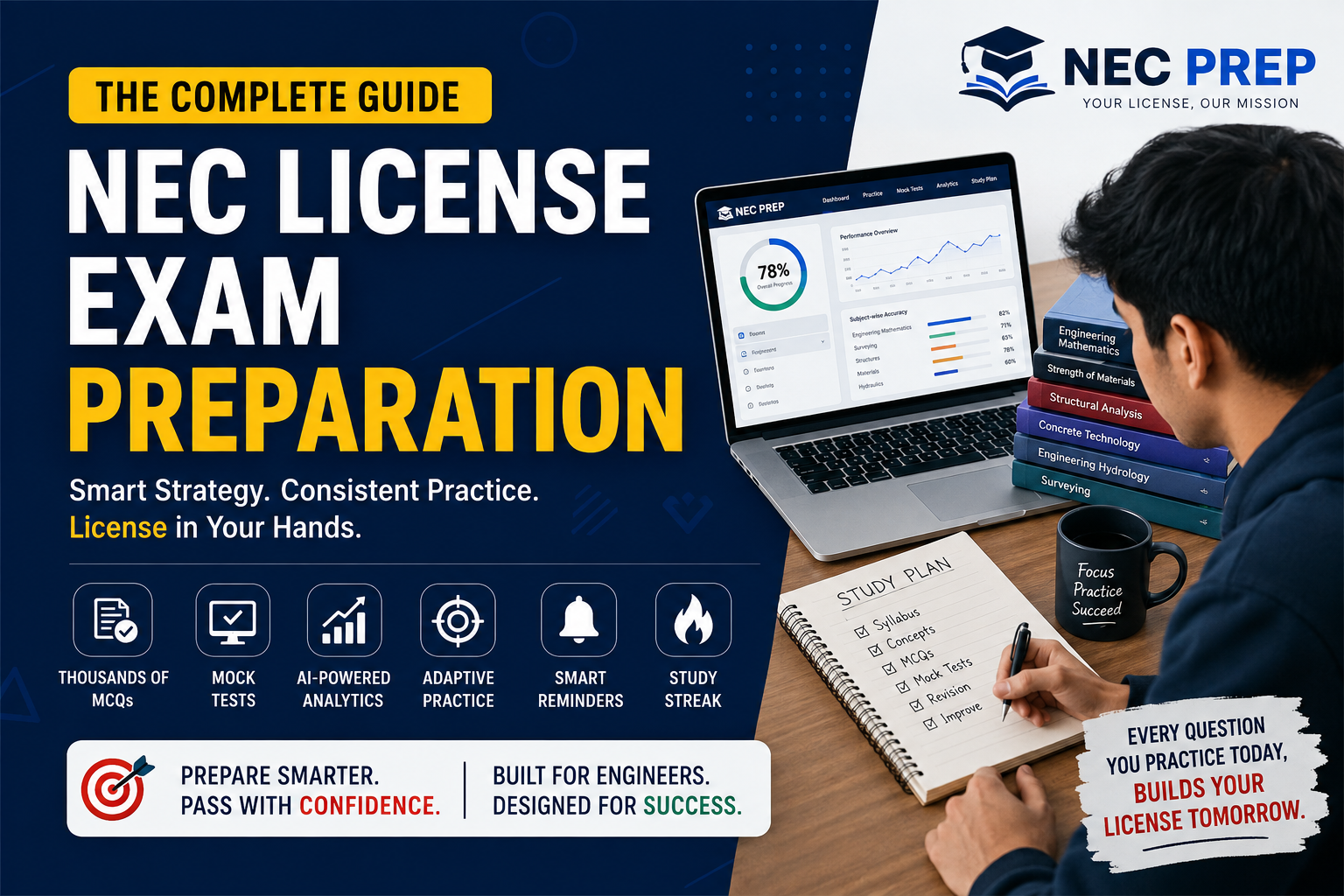
NEC License Exam Preparation: The Complete Guide for Engineering Graduates in Nepal
Preparing for the Nepal Engineering Council (NEC) License Exam is more than simply reading engineering books. You need to understand the syllabus, practice questions regularly, identify your weak areas, improve your accuracy, and know when you're actually ready for the exam.
For many engineering graduates, the biggest challenge isn't finding study materials. It's creating a structured preparation system that helps them study consistently and measure their progress.
Whether you're preparing for Civil Engineering, Computer Engineering, Electrical & Electronics Engineering, Mechanical Engineering, or another engineering discipline, having the right preparation strategy can make your journey much more organized.
In this guide, we'll explore how to prepare effectively for the NEC License Exam and how modern tools such as AI-powered tutoring, adaptive tests, MCQ practice, analytics, and mistake tracking can make your preparation smarter.
What Is the NEC License Exam?
The Nepal Engineering Council (NEC) is the regulatory body responsible for engineering registration and professional practice in Nepal.
For engineering graduates preparing for the licensing examination, it is important to understand the applicable syllabus, examination requirements, registration procedures, and official notices before beginning your preparation.
Always refer to the latest information published by the Nepal Engineering Council for official examination-related information.
Once you understand the requirements, the next step is building a preparation plan that works for you.
Why Is NEC License Exam Preparation Challenging?
Engineering students spend years learning technical concepts, formulas, theories, and practical applications.
But an examination requires a different skill:
You need to recall and apply that knowledge accurately under exam conditions.
Many students face challenges such as:
Not knowing where to start
Having too many study materials
Spending too much time on theory
Not practicing enough MCQs
Repeating the same mistakes
Struggling to identify weak topics
Taking mock tests too late
Losing consistency during preparation
Not knowing whether they are actually exam-ready
This is why simply studying for more hours isn't always the best solution.
The goal should be to study smarter, practice consistently, and understand your performance.
The Right NEC Preparation Cycle
An effective preparation strategy can be built around a simple cycle:
Learn → Practice → Analyze → Improve → Repeat
Learn the concept.
Practice questions related to that concept.
Analyze your mistakes and performance.
Improve the areas where you're struggling.
Then repeat the process.
This turns preparation from passive studying into an active learning process.
1. Start With the NEC Syllabus
Before solving hundreds of questions, understand what you actually need to prepare.
Break the syllabus into smaller topics and organize them based on your current knowledge.
You can divide topics into three categories:
Strong Areas
Topics you already understand and can answer confidently.
Moderate Areas
Topics where you understand the fundamentals but need more practice.
Weak Areas
Topics where you frequently make mistakes or struggle to remember concepts.
This simple classification gives you a much clearer preparation roadmap.
Instead of asking:
"How many chapters have I completed?"
ask:
"Which topics still need improvement?"
2. Practice MCQs Consistently
Reading theory is important, but MCQ practice is essential for exam preparation.
After studying a topic, practice questions from that topic.
For example:
Study a concept → Solve MCQs → Check answers → Review mistakes → Practice again
The objective isn't simply to solve as many questions as possible.
The real objective is to understand why you got a question right or wrong.
If you repeatedly make mistakes in the same topic, that is a clear signal that the topic needs more attention.
3. Stop Ignoring Your Mistakes
One of the most valuable parts of preparation is often overlooked:
Your incorrect answers.
When you get a question wrong, don't immediately move to the next question.
Ask yourself:
Did I forget the concept?
Did I misunderstand the question?
Did I forget a formula?
Did I confuse two similar concepts?
Did I make a calculation mistake?
Did I answer too quickly?
Understanding the reason behind your mistake helps you prevent the same mistake in the future.
This is why maintaining a mistake review system can be extremely useful during NEC preparation.
4. Know Your Weak Areas
Imagine you have completed hundreds of MCQs but don't know which chapters are actually holding you back.
You may continue spending time on topics you're already good at while ignoring the areas that need improvement.
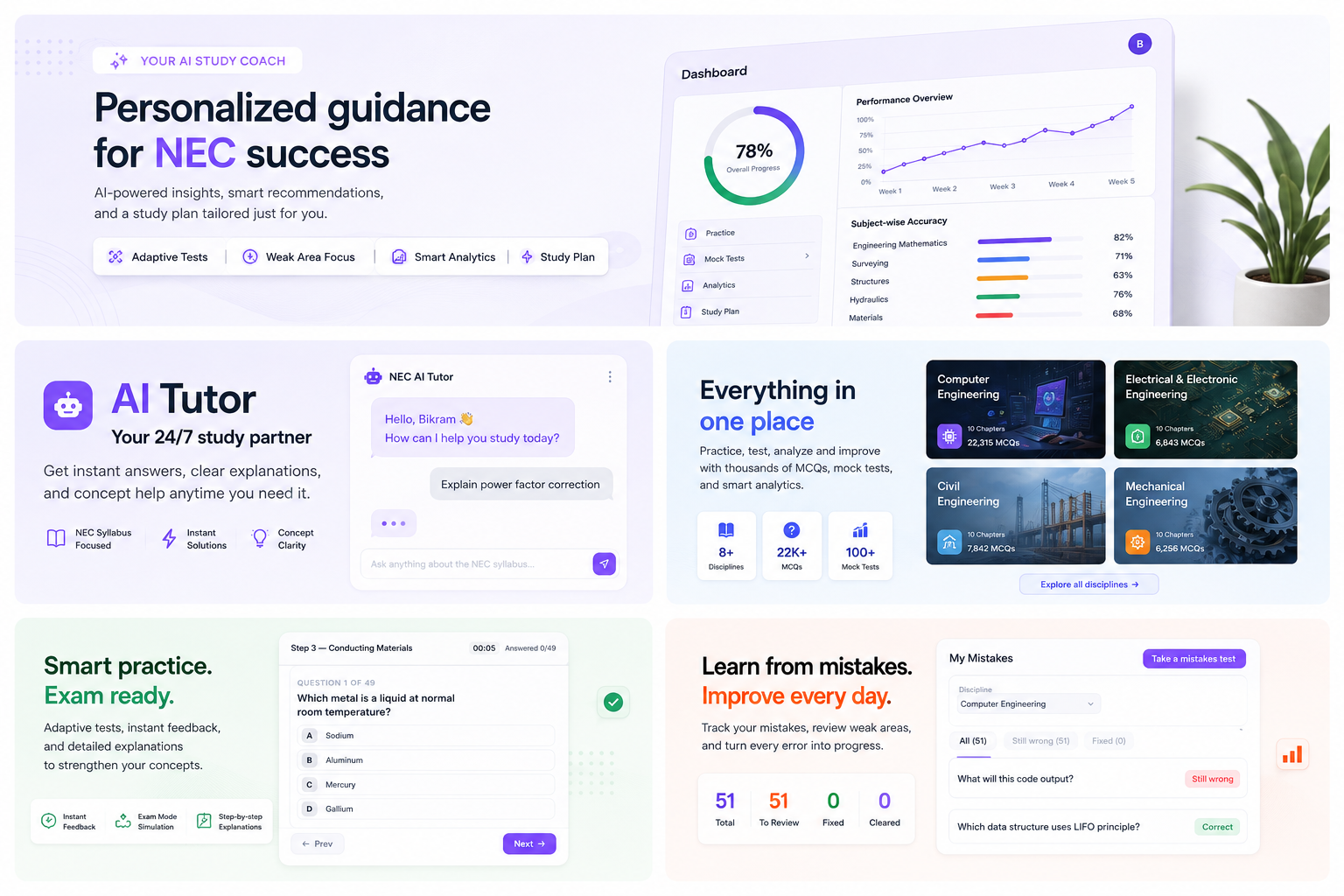
Performance analytics can solve this problem.
A good preparation system should help you understand:
Your overall accuracy
Subject-wise performance
Chapter-wise performance
Frequently missed questions
Improvement over time
Areas that require more practice
Your performance should decide what you study next.
5. Use Adaptive Tests
Not every student has the same strengths and weaknesses.
That's why a one-size-fits-all preparation approach isn't always ideal.
An adaptive test can use your previous performance to create a more personalized practice experience.
For example:
If you're performing strongly in one topic, you can move forward.
If you're consistently struggling in another topic, you can spend more time practicing it.
This creates a continuous feedback loop:
Performance → Weak Areas → Targeted Practice → Improvement
Instead of simply completing a fixed list of questions, your preparation becomes more personalized.
6. Take Mock Tests Regularly
There is a difference between knowing engineering concepts and being able to perform under exam conditions.
That's where mock tests become important.
Regular mock tests help you practice:
Time management
Accuracy
Question selection
Speed
Exam pressure
Full-syllabus practice
But remember:
A mock test isn't only about your score.
The most important part is what you learn after the test.
After every mock test:
Take the test → Analyze the result → Find weak areas → Revise → Test again
Your first mock test doesn't need to be perfect.
It needs to show you where you currently stand.
7. Track Your Exam Readiness
How do you know whether you're actually ready for the NEC License Exam?
Completing the syllabus isn't enough.
You should also consider:
Is your accuracy improving?
Are your weak areas decreasing?
Are you making the same mistakes repeatedly?
Can you solve questions within the required time?
Are your mock-test scores becoming more consistent?
Can you perform across different topics?
A dedicated exam-readiness score can make this easier to understand by turning your preparation progress into measurable information.
Instead of guessing whether you're ready, you can use your preparation data to make a more informed decision.
8. Build a Consistent Study Habit
You don't necessarily need to study for 10 hours every day.
What matters is consistency.
A focused daily routine could look like:
30 minutes — Concept revision
45 minutes — MCQ practice
15 minutes — Mistake review
15 minutes — Weak-topic revision
The exact schedule can change depending on your availability.
The important thing is to create a routine that you can maintain.
Consistency beats last-minute preparation.
9. Use Smart Reminders to Stay on Track
Preparation can easily lose momentum.
You may plan to practice today and postpone it until tomorrow. Then tomorrow becomes another day.
Smart notifications and reminders can help you stay connected with your preparation activities.
You can receive reminders related to:
Daily practice
Pending activities
Mock tests
Study plans
Revision
Preparation goals
Instead of relying completely on motivation, build a system that keeps your preparation moving.
10. Use AI as Your Study Assistant
One of the biggest changes in modern education is the ability to use AI as a personalized study assistant.
Instead of searching through multiple resources whenever you have a question, an AI tutor can help you:
Understand difficult concepts
Ask questions about the syllabus
Get explanations
Review concepts
Practice questions
Clarify confusing topics
For engineering students, this can make difficult concepts easier to revisit during preparation.
Your AI tutor should support your learning—not replace it.
Use AI to understand concepts, ask questions, and strengthen your preparation while continuing to rely on proper study materials and official examination information.
11. Prepare According to Your Engineering Discipline
NEC preparation isn't identical for every engineering student.
Your preparation should reflect your discipline and syllabus.
For example, preparation may include different topics and question sets for:
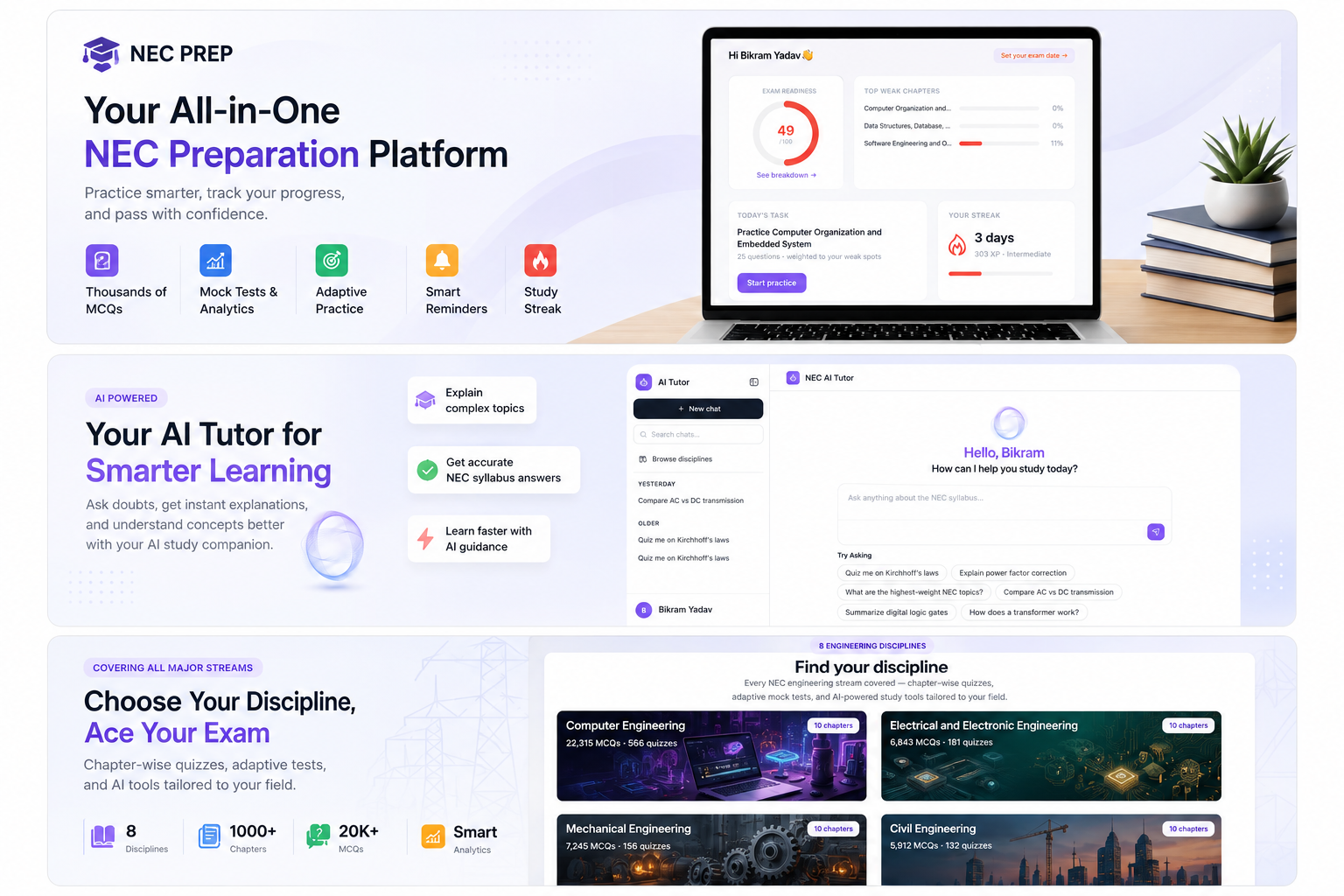
Computer Engineering
Civil Engineering
Electrical & Electronics Engineering
Mechanical Engineering
Electronics & Communication Engineering
Architecture
And other engineering disciplines
A platform that organizes preparation by discipline and chapter makes it easier to focus on the material relevant to your examination.
A Simple 30-Day NEC Preparation Strategy
If your examination is approaching, you can divide your preparation into four phases.
Days 1–7: Understand & Assess
Review the syllabus
Revise important concepts
Start topic-wise MCQs
Identify weak areas
Establish your daily routine
Goal: Understand where you currently stand.
Days 8–15: Practice & Improve
Increase MCQ practice
Focus on weak topics
Review incorrect answers
Revise difficult concepts
Track your accuracy
Goal: Strengthen your weak areas.
Days 16–23: Test Yourself
Take regular mock tests
Practice under time pressure
Analyze every test
Review repeated mistakes
Focus on low-performing topics
Goal: Improve exam performance.
Days 24–30: Final Revision
Revise weak areas
Review your mistakes
Practice important questions
Take full-length mock tests
Improve speed and accuracy
Goal: Enter the exam with confidence in your preparation.
What Makes a Modern NEC Preparation Platform Different?
Traditional preparation often looks like:
Books → Notes → PDFs → Questions → More Notes
The problem is that your preparation can become scattered.
A modern preparation platform brings the important parts together:
MCQ Practice
Practice questions organized around your engineering discipline and topics.
Mock Tests
Simulate exam-style practice and evaluate your performance.
AI Tutor
Ask questions and get help understanding difficult concepts.
Adaptive Tests
Practice based on your performance and areas that need attention.
Analytics
Understand your accuracy, performance, and weak areas.
Mistake Tracking
Keep track of questions you've answered incorrectly and revisit them.
Study Plans
Turn a large syllabus into manageable preparation activities.
Smart Notifications
Stay consistent with reminders about your preparation activities.
Streaks
Build a daily practice habit and maintain momentum.
NEC Prep: One Place for Smarter NEC Preparation
Preparing for the NEC License Exam doesn't have to mean jumping between different PDFs, notes, question banks, and random practice resources.
NEC Prep brings your preparation into one structured environment.
You can practice MCQs, take tests, identify weak areas, review mistakes, track your performance, use AI-powered study assistance, and build consistent preparation habits.
The idea is simple:
Practice more. Understand your performance. Improve every day.
Your engineering degree has already given you the foundation.
Now it's time to turn that knowledge into exam-ready preparation.
Ready to Start Your NEC Preparation?
Don't wait until the final days before your exam to discover your weak areas.
Start practicing.
Start testing yourself.
Start tracking your progress.
Start improving.
Prepare smarter. Practice consistently. Get NEC exam ready.
Start your preparation with NEC Prep today.
[Start NEC Preparation →]